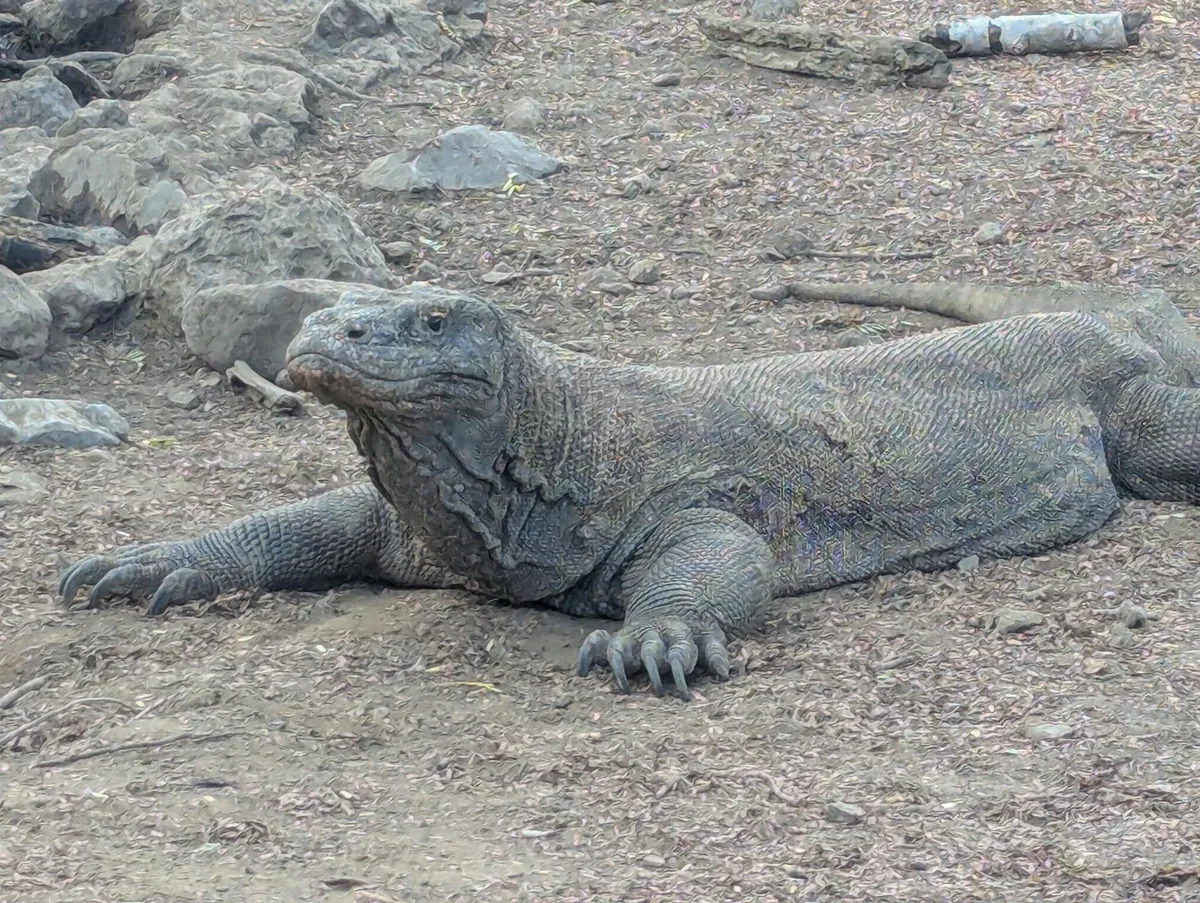
Komodo Dragon Trekking: Komodo vs Rinca, What to Expect
Komodo dragons—the world's largest lizards at up to 3m long—live wild on Komodo, Rinca, Padar, and Gili Motang islands in Komodo National Park. Rinca Island offers the most reliable sightings due to open savannah terrain and is closer to Labuan Bajo (1.5 hours); Komodo Island is larger and can be combined with Pink Beach. All visits require a licensed park ranger guide; fees include a national park entrance ticket plus the Rp 3.75 million conservation levy introduced in 2023.
The Komodo dragon is the world’s largest living lizard. Varanus komodoensis, 3 metres of scaled, venom-carrying, ambush-hunting predator, exists naturally only on four small islands in this corner of Indonesia. Nowhere else on earth, outside of captivity. This is the only place.
Standing three metres from a wild Komodo dragon, with nothing between you and it except a park ranger with a forked stick, is a genuinely unusual experience.
What Komodo Dragons Actually Are
The classification was settled long ago, Varanus komodoensis, family Varanidae, largest of the monitor lizards. Some basics that many visitors don’t know:
Size: Adults average 2–2.5 metres. Males can reach 3 metres and 70 kg. Females are smaller (~1.5 m). Juveniles are striped and much smaller; they spend their first years in trees to avoid being eaten by adults.
Speed: In short bursts, up to 20 km/h. They don’t sustain this pace but the initial sprint is faster than most people expect from something their size.
Venom: Revised understanding since 2009. Komodo dragons have venom glands in their lower jaw that secrete anticoagulant compounds. Combined with bacteria in their mouths, a bite that does not kill immediately can cause severe infection and blood loss. Large prey (deer, boar, water buffalo) bitten and not immediately killed are tracked until they weaken.
Reproduction: Females can reproduce parthenogenetically, offspring from unfertilized eggs. This was discovered in captive specimens and has been observed in wild populations.
Lifespan: Up to 30 years in the wild.
The Trek: What Actually Happens
You arrive at either Loh Liang (Komodo Island) or Loh Buaya (Rinca Island). A licensed ranger assigns to your group, groups are kept at 4–8 people maximum. You choose a loop (short/medium/long).
The ranger leads. You follow. You do not walk ahead of the ranger or linger behind. The forked wooden stick is used to physically push a dragon away if it gets too close, not as a weapon.
On Rinca, the dragons are often encountered immediately at the ranger station. Large adults bask near the kitchen building, having learned that food scraps accumulate there. Some of the Loh Buaya residents are very large, 2.5–3 m specimens are common.
On Komodo Island, the forest terrain means dragons are found at different points on the loop. The watering hole area (medium/long loop) is productive in the morning.
Photography: Rangers stop at close approach when a dragon is in view. You have time to photograph. Use a telephoto lens if you have one, 3 metres feels close enough.
Safety Rules (Non-Negotiable)
- Stay with your ranger at all times
- Do not turn your back on a dragon
- Do not crouch down to eye level
- Do not run under any circumstances
- Do not carry food on your person
- Women who are menstruating are advised to be especially cautious (dragons detect blood at range)
- If a dragon approaches: let the ranger handle it, do not jump, do not run
In 40+ years of commercial tourism at Komodo, the number of serious injuries to visitors following these rules is very small.
Which Island Should You Choose?
| Rinca | Komodo Island | |
|---|---|---|
| Boat journey | 1 hour | 2 hours |
| Terrain | Open savannah | Mixed forest/savannah |
| Dragon visibility | Higher (open terrain) | Slightly lower |
| Crowds | Lower | Higher |
| Combined with | Padar Island | Pink Beach |
| Price (boat hire) | Lower | Higher |
Most guides recommend Rinca for first-time visitors: reliable sightings, shorter journey, lower cost. Komodo Island is worth the extra time if you want to see Pink Beach and have a full day.
What Is It Like to Stand Near a Komodo Dragon?
This is the part the numbers don’t capture. A large adult Komodo dragon at 2.5 metres and 60 kilograms is bigger than most people expect from photographs. When one turns to look at you, forked tongue testing the air, the instinct is to step back.
The ranger is there. The forked stick is there. The dragon has no particular interest in you unless you make yourself interesting by running or carrying food.
What is remarkable is the complete indifference. These animals are not afraid of humans. They’re not aggressive by default, they’re efficient, and they are simply going about their morning. You are an irrelevance. This is their island.
Most people feel something at this moment. It’s difficult to describe it exactly, but it is not the same as seeing an animal in a zoo.
What Else Lives on These Islands?
The Komodo dragon is the apex predator of an island ecosystem that includes other wildlife worth watching:
Timor deer (Cervus timorensis): The dragon’s primary prey. Herds of deer are common on both Rinca and Komodo Island, often visible from the trekking trails. Their relationship with the dragons is visibly tense.
Wild boar and water buffalo: Both present and both prey species. Water buffalo can live with dragon bites, the venom weakens them over days. Seeing a buffalo with old bite wound scars is not unusual.
Sulphur-crested cockatoos: Raucous and visible in the trees near both ranger stations. Endemic to this part of Indonesia.
Short-tailed macaques: Common at both Loh Buaya (Rinca) and Loh Liang (Komodo Island). Young macaques sometimes sprint across the clearing while a dragon watches from 10 metres. The monkeys lose this calculation sometimes.
Marine life: The sea around both islands is part of Komodo National Park’s marine protected area. Dugong, sea turtles, and reef sharks are regularly seen from boats in the channels.
How Do You Book a Komodo Dragon Trek?
You cannot visit Komodo or Rinca islands independently of a ranger guide, and all visits require the national park entrance fee. Practical booking options:
Shared day tour from Labuan Bajo: The most common approach. IDR 450,000-700,000 per person including park entrance, boat, basic lunch. Multiple boats run daily.
Private boat charter: IDR 2,500,000-4,000,000 per boat for a group of 4-8. More flexible timing and itinerary.
Liveaboard: Both islands are standard stops on the Lombok-Komodo liveaboard route.
Ranger fee: Included in the park entrance (IDR 650,000 for Komodo/Padar, IDR 900,000 for Rinca as of 2025). You don’t pay the ranger separately.
For any boat booking: confirm that the park entrance fee is included. Some operators quote the boat price only, and the entrance is a significant additional cost.
Rinca Island guide → Komodo Island guide → Komodo National Park fees →
Frequently asked questions
Are Komodo dragons dangerous?
Yes, they are genuinely dangerous wild animals and should be treated accordingly. Komodo dragons can sprint at 20 km/h over short distances, have powerful claws and serrated teeth, and possess venom glands that prevent blood clotting in bite wounds. Serious attacks on humans are rare (several documented cases over decades) and mostly occurred when visitors broke safety rules. Stay within arm's reach of your ranger, do not approach dragons without permission, and do not run. The forked sticks rangers carry are not decorative.
Where is the best place to see Komodo dragons?
Both Komodo Island and Rinca Island offer reliable sightings. Rinca is recommended for first-time visitors: it's 1 hour from Labuan Bajo (vs. 2 hours for Komodo Island), the open savannah terrain makes dragons easy to spot, and the Loh Buaya ranger station has resident dragons that are reliably present in the morning. Komodo Island has a larger population (~2,500 vs. ~1,300 on Rinca) but the terrain is more forested and sightings are less guaranteed.
What do the trekking routes look like?
Both islands offer short (1 km, 30 minutes), medium (2 km, 1 hour), and long (3–4 km, 2 hours) loops departing from the ranger stations. Short loops pass through the main dragon habitat near the station. Long loops cover more varied terrain, savannah, forest edge, coastal ridge, and give better chances of seeing deer, wild boar, water buffalo, and birds alongside the dragons. All loops are guided.
What is the best time of day to see Komodo dragons?
Early morning (8–10 AM) is best. Dragons are cold-blooded and spend the first hours of the day warming up in open areas, on trails, near the ranger kitchen, on sunny rocks. By noon they shelter in shade and become harder to spot. The 'best' day tours depart Labuan Bajo by 7–8 AM to reach the islands by mid-morning.
What is the park entrance fee?
IDR 650,000 per person (~USD 40) for Komodo Island and Padar Island, or IDR 900,000 per person for Rinca Island (as of 2025). Always verify current fees with your operator when booking, as rates can change.
How many dragons will I see?
On Rinca at Loh Buaya: typically 3–10 individuals on the short and medium loops, including large adults near the ranger kitchen. On Komodo Island's short loop: 2–6 dragons on average. Sightings depend on time of day, season, and a degree of luck. In dry season (May–October), dragons are more active in the mornings. Nobody leaves either island without seeing at least one dragon.
Can I visit Komodo National Park independently without a tour?
Not practically. You need a boat from Labuan Bajo, and independent boat hire is expensive and logistically complex. All island visits require a licensed park ranger guide (included in the entrance fee). Most visitors book a shared or private day tour from Labuan Bajo, the easiest and most cost-effective option.